 Skip to main content

Ticket header
Support by Time module WHMCS
Order now | Download | Community
Time-logging header
Whenever an administrator opens a ticket in the WHMCS admin area, the module injects a context-aware header above the ticket. The header loads its state over AJAX and renders entirely client-side — every action (save, close, reopen, timer, order) happens without reloading the page. It detects the situation (active service, terminated service, no service, ticket charged in a previous month, ticket closed, license issue) and renders the appropriate UI.
Open ticket — time form
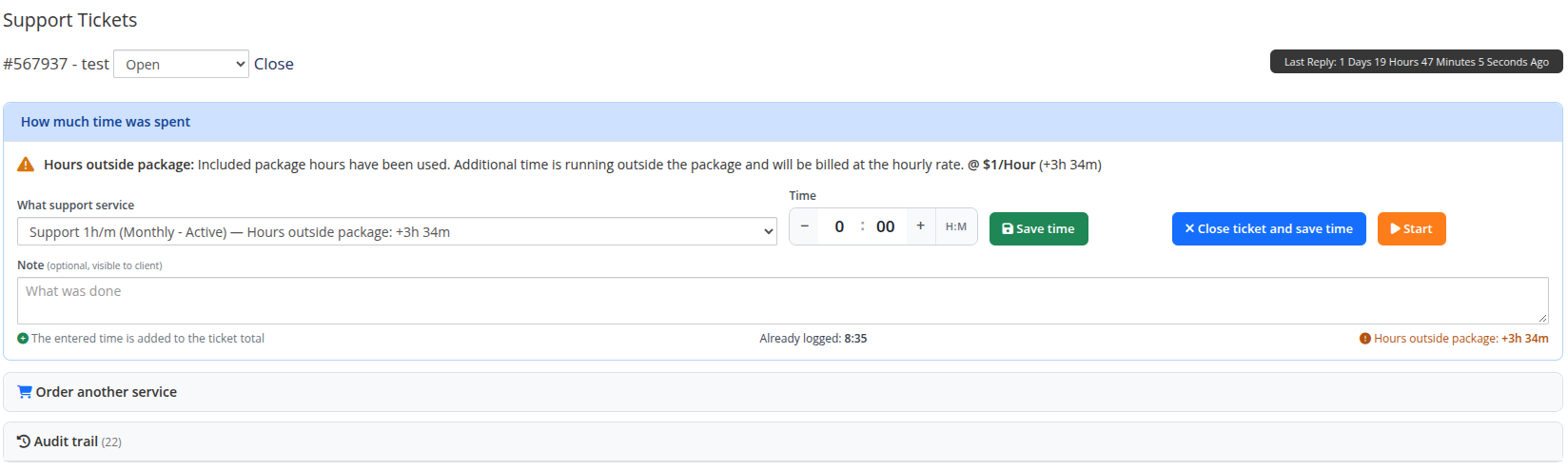 15-ticket-time-form.png
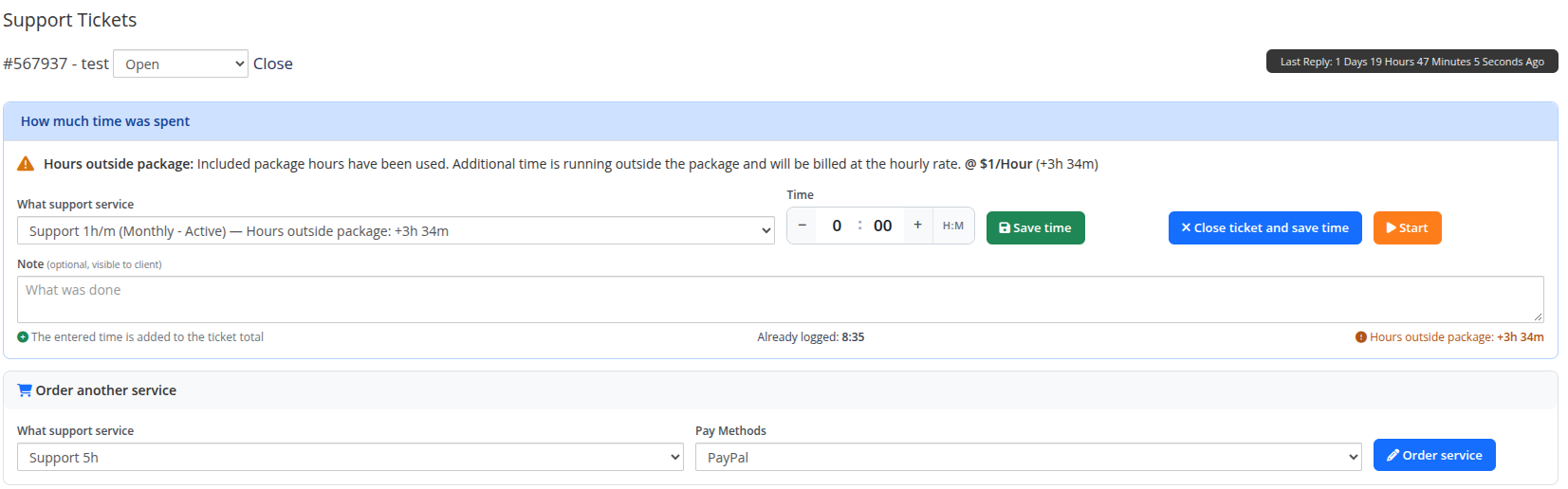
The default view is a panel containing:
-
Service selector: A drop-down listing all customer support services. Active services are listed first with
Activepriority, followed by suspended and terminated services. Each entry displays package allocation and remaining hours:Service name (cycle - status) — Available: 3h 17m / 5h.- Smart default selection: When opening a ticket with no hours logged yet, the header automatically pre-selects the first usable Active service (prioritizing packages with available quota).
- Reactive switching: Switching services updates the form immediately without page reload, recalculating available time and adjusting controls while preserving any text already typed into the Note field.
- An HH:MM time input with
−/+buttons (minute steps; minutes roll over into hours). For One Time services the value is automatically capped at the hours remaining in the bucket. - An optional Note field (visible to the client when Show work log to client is enabled on the product).
- Action buttons:
- Save time — appends the entered time as a new entry; the ticket stays open.
- Close ticket and save time — appends the entry and sets the WHMCS ticket status to Closed.
- Start — starts a live timer (see below).
Each save adds a new entry to the ticket — it does not overwrite previous entries. The running total ("Already logged") and the full breakdown are shown in the audit trail.
Dynamic button state and status guard
- Active recurring service: Buttons and inputs are always enabled. If usage exceeds included quota, an orange notice displays the overage rate per hour.
- Active One Time service with hours remaining: Buttons and inputs are enabled; the maximum loggable time is capped at the remaining bucket hours.
- Active One Time service exhausted (0 hours left): Action buttons (Save time, Close & save, Start) and the time input are disabled. A red notice informs: Package hours exhausted. All prepaid hours for this One Time service have been used. Additional time cannot be added. Please order a new support package.
- Non-Active service (Terminated / Suspended): Action buttons and inputs are disabled, and a warning alert is displayed: Selected service is {Status}. You cannot log time to this service.
- Instant unblocking: If an operator switches in the drop-down from a Terminated or Suspended service to an Active service, the alert banner disappears immediately and all action buttons and inputs are unblocked without reloading the page.
-
Backend security validation: All backend endpoints (
save_time,timer_start,SetItem) enforcedomainstatus === 'Active'. Any attempt to log time or start a timer against a non-Active service is rejected at the server level.
Audit trail
Below the form, a timeline lists every action taken on the ticket (time logged, edited, deleted, timer start/stop/cancel, service ordered), with the operator name and a relative timestamp.
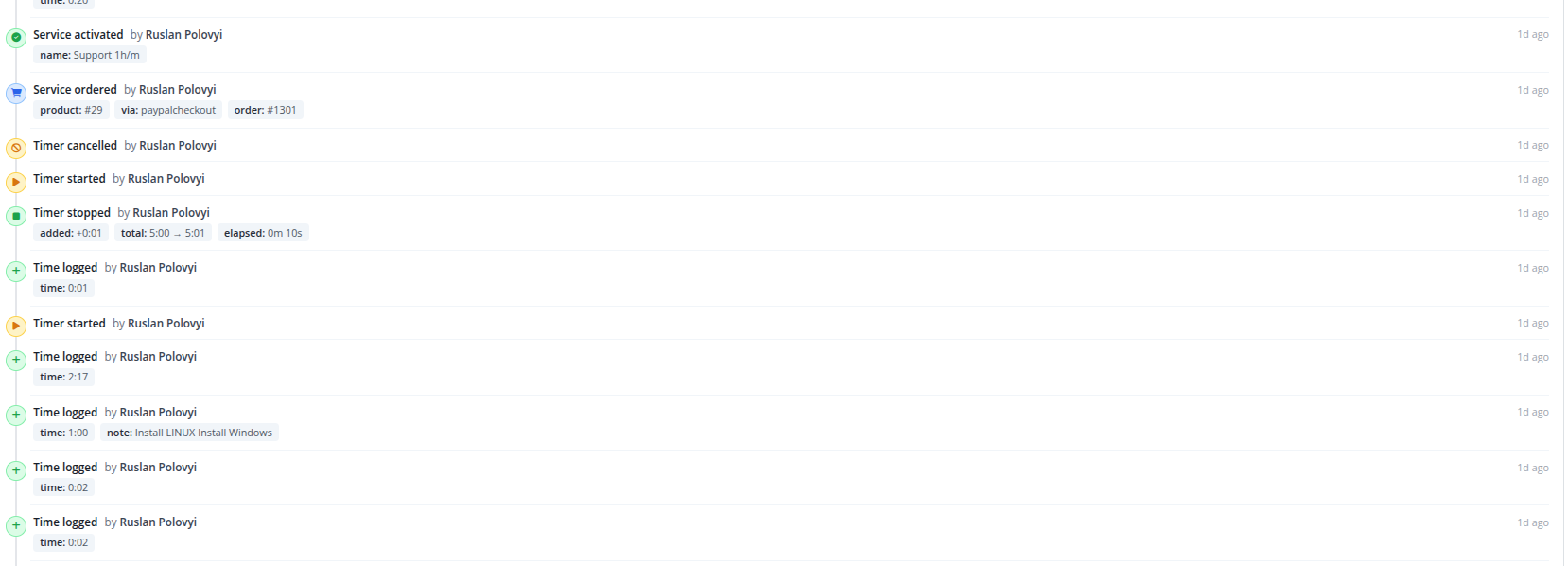 16-ticket-time-form-audit.png
Live timer
Pressing Start opens a red Timer running panel with a server-anchored running clock and Stop / Cancel buttons. Stop rounds the elapsed time up to the nearest minute and appends it as a regular time entry (with the note, if any); Cancel discards it.
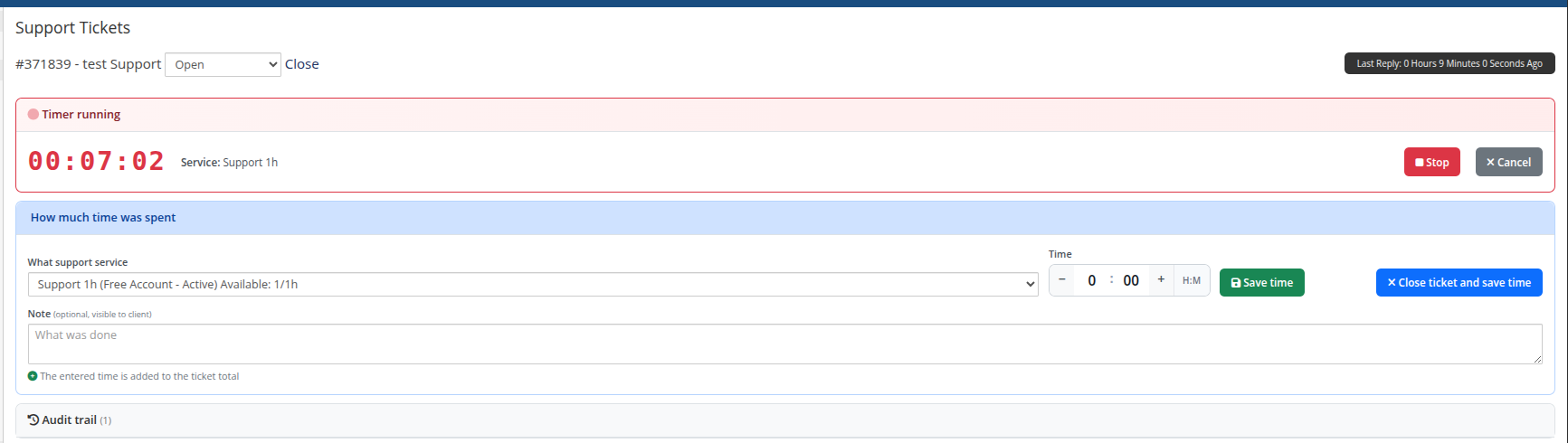 17-ticket-timer-running.png
After stopping, the action is recorded in the audit trail (elapsed time, added hours, new total):
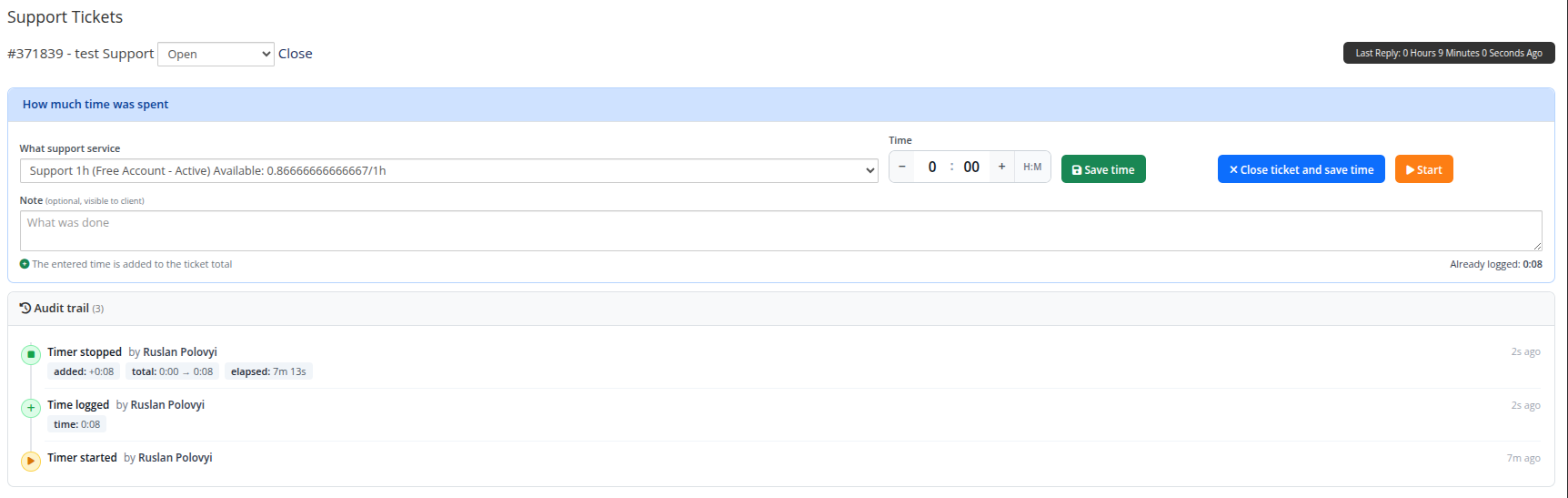 18-ticket-timer-audit.png
Closed ticket
 19-ticket-closed.png
When the ticket is closed, the header shows a compact summary (logged time + service) plus a ReOpen button that switches the WHMCS ticket status back to Open so the operator can log more time. If the ticket has already been billed, ReOpen is refused (the time is locked).
Ticket charged in a previous month
 20-ticket-past-month.png
If the ticket's time belongs to a previous month, editing is locked: the header shows a red panel with the recorded time, the service, and a hint to recreate or split the ticket if more time needs to be logged. This prevents retroactive changes after the monthly billable item has been created.
Inactive or terminated service handling
If a ticket has existing logged time associated with a service that has since been terminated or suspended:
- The header displays an alert informing that the selected service is not active and time cannot be added to it.
- If the customer has other active services, the operator can simply switch to an active service in the drop-down — the buttons unblock immediately.
- If the customer has no active services, the operator can order or activate a new package directly from the ticket header using the inline order form.
Client without a support service
 21-ticket-order-service.png
If the client does not yet have an Active or Suspended Support by Time service, the header shows an inline order form: a drop-down with all available Support by Time products and a drop-down with available WHMCS payment methods. Submitting it creates a WHMCS order, accepts it, runs auto-setup and reloads the ticket.
License issue
When any of the customer's Support by Time products has an invalid or unreachable license, the header shows a red banner instead of the time form, with the product name and the error message returned by the license server.